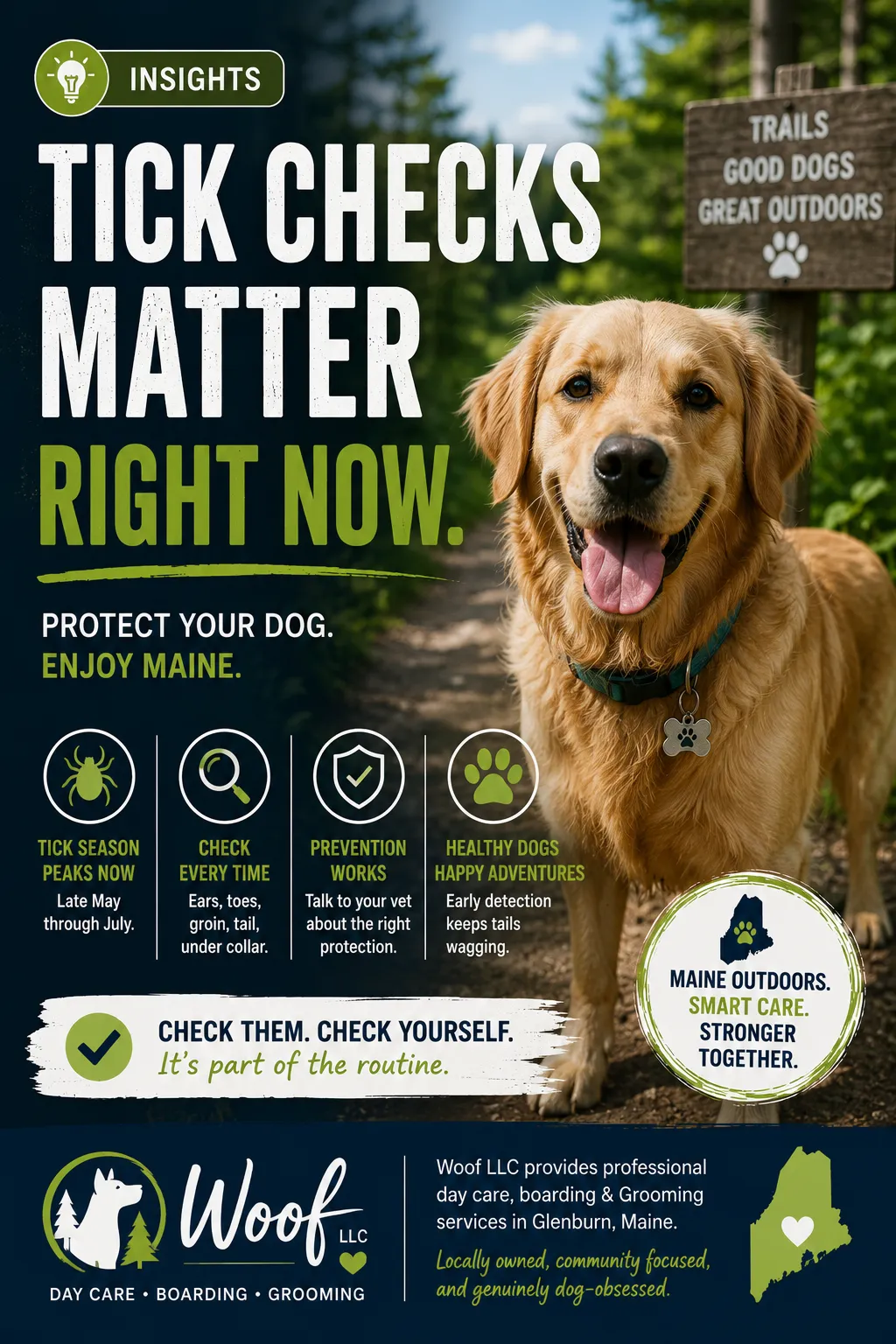
Tick Season Is Here in Bangor — What Every Dog Owner Needs to Know
If you have been walking your dog in Bangor this month — on trails, through tall grass, along wooded edges, even in some backyards — tick checks need to be part of the routine right now.
Maine has one of the highest rates of Lyme disease in the country. Penobscot County is not an exception. Late May through July is when tick activity peaks and when the risk of transmission is highest. This is not meant to scare anyone away from being outside with their dog. Being outside is good for both of you. It just means coming in with a plan.
Why Late May Is Prime Tick Time in Maine
Deer ticks — the ones that transmit Lyme disease — are active in two main life stages that concern dog owners. Adult ticks are most active in fall and early spring. Nymphs, which are tiny and harder to spot, are most active from late May through July.
Nymphs are the higher-risk life stage for Lyme transmission precisely because they are so small — about the size of a poppy seed — and easy to miss during a check. They are active right now. That is why this time of year matters.
Ticks do not jump or fly. They wait on the tips of grass and low vegetation and attach when a warm body passes. Your dog brushing through tall grass on a trail, through a brushy field edge, or along a stone wall is picking up ticks. So are you.
How to Check Your Dog After Every Walk
A tick check does not take long but it needs to be thorough. Ticks head for warm, hidden spots. On dogs that means the ears — inside the flap and around the base. The area between the toes. The groin and inner thighs. Around the tail. Under the collar.
Run your fingers slowly through the coat and against the skin. You are feeling for small bumps that were not there before. On a dark-coated dog this is especially important to do by feel and not just by sight.
If you find a tick that is not yet attached, remove it and dispose of it. If you find one that is attached, use fine-tipped tweezers, grasp it as close to the skin as possible, and pull straight out with steady pressure. Do not twist, do not use heat, do not cover it with petroleum jelly. Clean the bite area with rubbing alcohol. Note the date and keep an eye on the spot.
Prevention Options Worth Knowing About
Talk to your vet about prevention. There are several effective options — topical treatments, oral preventatives, and tick collars — and the right one depends on your dog's size, health, and lifestyle. Your vet knows your dog and can make a recommendation that fits.
Keep your yard less hospitable to ticks by keeping grass mowed, clearing leaf litter from edges and corners, and creating a buffer between lawn and any wooded areas if possible. Ticks do not thrive in dry sunny grass — they concentrate in shaded, moist areas at the edges.
Signs to Watch For After a Tick Exposure
Lyme disease in dogs does not always show obvious symptoms right away. The signs to watch for in the weeks following a tick bite include lameness that seems to shift from leg to leg, reduced appetite, fever, lethargy, and swelling around joints.
If you notice any of those signs, call your vet. Early treatment is straightforward and effective. Untreated Lyme disease in dogs can cause serious kidney complications.
One more note: if you are doing tick checks on your dog, check yourself too. Nymphs are just as interested in you.
Get outside. Enjoy the trails. Just come home and check.
AUTHOR BIO LINE: Woof LLC provides professional day care, boarding & Grooming services in Glenburn, Maine. Locally owned, community focused, and genuinely dog-obsessed.